
Ordering artificial grass for a cricket pitch is not like ordering for football or tennis. The ICC match strip is just 20.12 m × 3.05 m — only 61 m². But a 6-lane practice facility? That is 436 m². A box cricket court? 500 m². The same sport, a 700% difference in order quantity.
Most buyers get this wrong. They search “cricket pitch size,” find 22 yards × 10 feet, order one roll, and discover it covers only the center strip — with nothing left for run-ups, practice lanes, or the crease markings.
This guide gives you the exact m², roll count, sand tonnage, and FOB cost for every type of cricket project. Use the calculator for instant numbers, or read on for the full breakdown by project type.
For non-standard layouts, our cricket artificial grass specialists will prepare a custom quote within 24 hours.
Use the calculator below to get exact quantities for your cricket project type.
🏏 Cricket Pitch Grass Calculator
Calculate strip, lane & box quantities — rolls & FOB cost
What "Cricket Pitch" Means for Your Order
The single biggest source of confusion in a cricket artificial grass order is scope. When a buyer says "I need a cricket pitch," the supplier cannot know whether that means a 32 m² school strip or a 10,000 m² outfield. The two quotes differ by more than 300×, and guessing wrong wastes weeks of production and shipping time.
Before requesting a price, you must pin down exactly which of the five scope types applies. Each one drives a completely different quantity, pile height, infill load, and shipping method. This is also why we built the calculator above — it branches automatically based on your project type.
A "cricket pitch" can mean five very different things:
- The match pitch strip (22 yards × 10 feet) — the small central playing area where the ball is bowled and bounces.
- A non-turf practice strip (smaller, for schools and clubs) — a reduced-cost synthetic strip for training.
- Practice net lanes (multiple parallel strips for training) — the most common B2B order for clubs.
- Box cricket / indoor facility (the entire enclosed playing area) — the fastest-growing segment in South Asia.
- The full ground outfield (the entire field carpeted) — very rare and expensive for artificial grass.
| Project Type | Typical Area | Order Qty (+10%) | FOB Cost Range |
|---|---|---|---|
| Match Pitch Strip | 61 m² | 67 m² | $810 – $2,363 |
| Practice Strip (Non-Turf) | 32 m² | 36 m² | $427 – $1,246 |
| Net Lanes (4-lane) | 264 m² | 290 m² | $3,480 – $10,150 |
| Box Cricket / Indoor | 400 – 600 m² | 440 – 660 m² | $5,280 – $23,100 |
| Full Outfield (rare) | 10,000+ m² | 11,000+ m² | $132,000+ |
The ICC Match Pitch Strip: 22 Yards of Precision
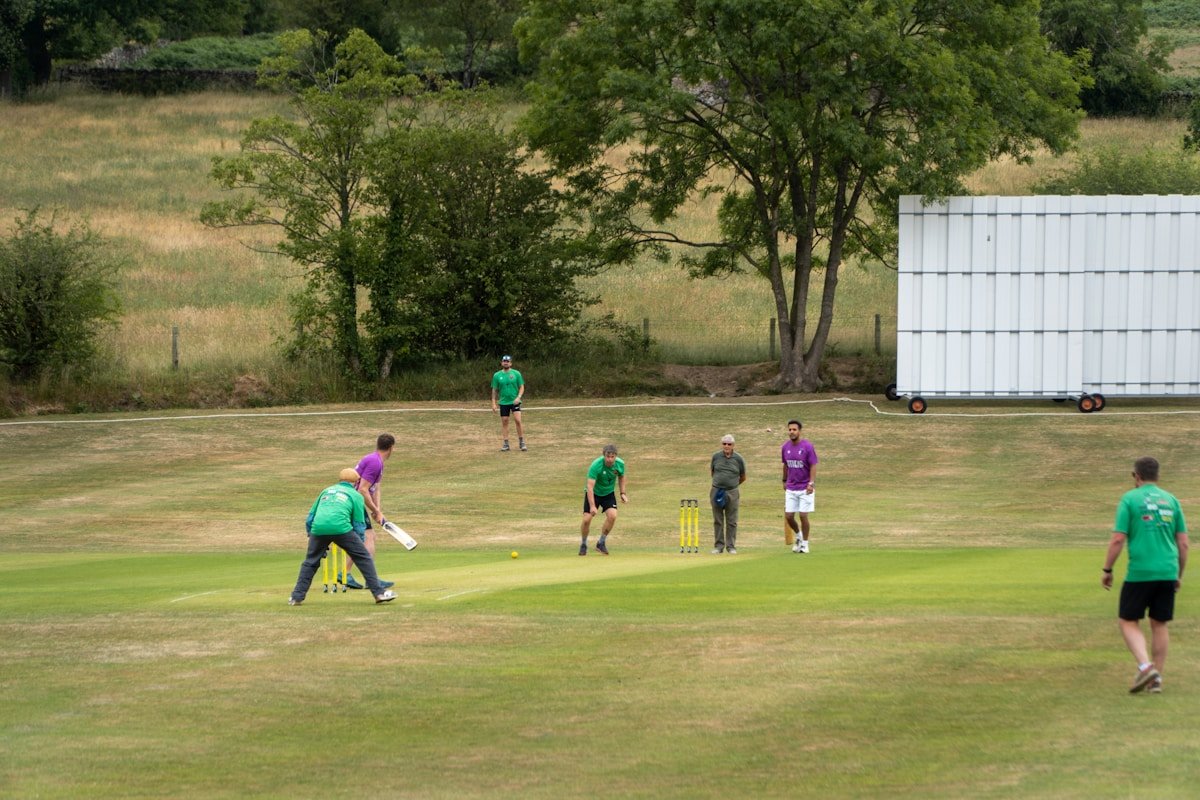
Under the MCC Laws of Cricket, the pitch is defined as 22 yards (20.12m) long and 10 feet (3.05m) wide. That works out to just 61.37 m² — a remarkably small area that nonetheless demands the most exacting manufacturing tolerance in the entire sports-surface industry.
This central strip is the only area that truly requires specialized cricket-grade artificial grass. The surface must deliver consistent ball bounce over its full length, because inconsistent bounce directly affects batting and bowling performance. A dense, low-pile carpet (typically 8mm) keeps the ball speed predictable off the surface.
Length: 22 yards = 20.12 m
Width: 10 feet = 3.05 m
Surface area: 61.37 m²
Non-turf minimum (ECB/MCC): 17.68m × 1.83m = 32.4 m²
Recommended pile height: 8 mm
Includes crease markings: popping crease, bowling crease, return crease (ICC-spec white)
The non-turf (synthetic) practice minimum per ECB/MCC guidelines is smaller: 17.68m × 1.83m = 32.4 m². This reduced footprint is what most schools and local clubs actually order, because it delivers genuine match-feel practice at a fraction of the full-strip cost.
Every match strip must also include the full set of crease markings — the popping crease, bowling crease, and return crease. These are either pre-fabricated into the carpet during production or painted on-site to ICC specification in white.
Practice Net Lanes: The Most Common B2B Order
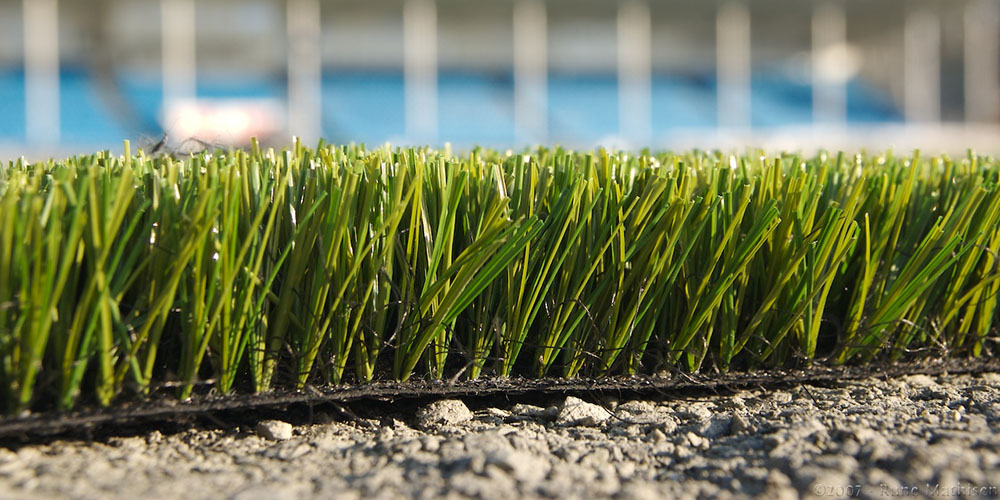
If you supply cricket facilities, practice net lanes are your bread and butter. Most clubs, academies, and schools do not need a match strip at all — they need a multi-lane training facility where several players can bat and bowl simultaneously behind nets. This is the most common commercial order in the cricket artificial grass market.
A standard practice lane is 22m long × 3m wide = 66 m² per lane. Lanes are laid parallel to each other, separated by netting, which means rolls can be run lengthwise for efficient material usage. Typical installations use 2, 3, 4, or 6 lanes depending on available space and budget.
| Lane Count | Surface Area | Order Qty (+10%) | Rolls (4m×25m) | FOB Cost Range |
|---|---|---|---|---|
| 1 Lane | 66 m² | 73 m² | 1 | $876 – $2,555 |
| 2 Lanes | 132 m² | 145 m² | 2 | $1,740 – $5,075 |
| 3 Lanes | 198 m² | 218 m² | 3 | $2,616 – $7,630 |
| 4 Lanes | 264 m² | 290 m² | 3 | $3,480 – $10,150 |
| 6 Lanes | 396 m² | 436 m² | 5 | $5,232 – $15,260 |
Practice surfaces do not need the match-grade 8mm pile. A 12mm pile height is the industry standard for lanes — it offers slightly more cushioning for repeated use, accepts sand infill well, and costs less per m² than the dense match-strip carpet.
Box Cricket Quantities: m², Rolls & Sand for Enclosed Courts
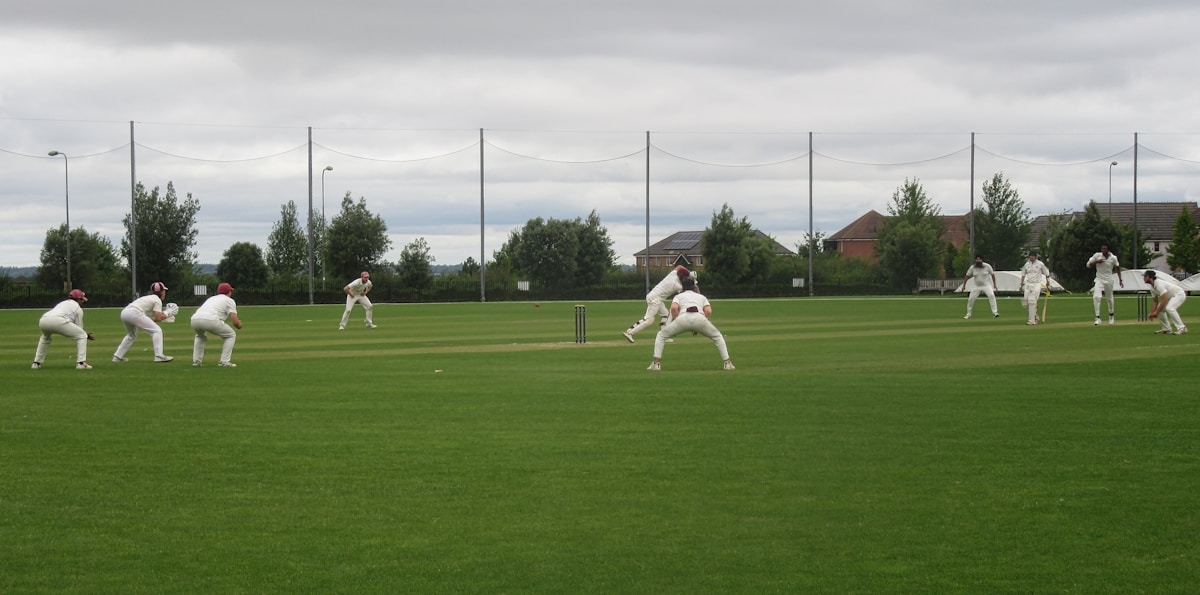
Box cricket — enclosed courts where the entire floor is carpeted — requires the largest artificial grass order of any cricket project type after full outfield carpeting. The playing area is not a narrow strip but a full rectangle, which means the order quantity rivals a small football field.
Standard box cricket dimensions range from 25–30m long × 15–20m wide. The most common configuration is 28m × 18m = 504 m². Because the surface sees multi-directional sliding and turning, it uses 12–15mm pile rather than the 8mm match strip specification, which means slightly more material weight per m².
| Box Size | Surface (m²) | Order Qty (+10%) | Rolls | Sand (5 kg/m²) | FOB Cost |
|---|---|---|---|---|---|
| 25m × 15m (small) | 375 | 413 | 5 | 1.9 t | $4,956 – $14,455 |
| 28m × 18m (standard) | 504 | 554 | 6 | 2.5 t | $6,648 – $19,390 |
| 30m × 20m (large) | 600 | 660 | 7 | 3.0 t | $7,920 – $23,100 |
Because box cricket surfaces use the same 4m-wide production rolls as every other sport, the waste factor on a 15–20m width is similar to padel: 3–5 strips cut from rolls, with offcut reduced by factory pre-cutting. For a standard 28m × 18m box, factory pre-cutting drops the order from 7 rolls to 6.
From 4m Roll to 3.05m Strip: Material Yield & Waste

The ICC match strip is 3.05m wide, but the production roll is 4m wide. That 0.95m difference — nearly a full meter of excess — is the single biggest source of waste in a cricket grass order if not managed correctly. Understanding the yield math tells you exactly how many strips one roll produces.
From a standard 4m × 25m roll (100 m²), the factory can cut:
| Item | Width Needed | Strips per Roll | Usable m² | Waste |
|---|---|---|---|---|
| Match strip (ICC) | 3.05m | 1 strip | ~61 m² | ~39% |
| Practice lane | 3.00m | 1 strip | ~66 m² | ~34% |
| Box cricket (28×18m) | 4.0m (full) | 4.5 strips | ~90 m² | ~10% |
This is why a single match strip (61 m²) requires a full 100 m² roll — the 0.95m width excess is unavoidable offcut. The factory can use that offcut material for crease marking inserts or approach strips, but it cannot be joined to make a second full strip. For multi-lane facilities, the waste drops because lanes are laid side by side and the 4m roll width is closer to the 3m lane width, leaving only 1m of offcut per roll.
1 match strip: 1 roll (61 m² usable of 100 m²)
2 practice lanes: 2 rolls (132 m² usable of 200 m²)
4 practice lanes: 3 rolls (264 m² usable of 300 m²) — offcut from lanes 1–3 feeds lane 4
Box cricket (504 m²): 6 rolls pre-cut (554 m² ordered) — best yield ratio
Sample PO: A 6-Lane Cricket Academy — Complete BOM
To show how every quantity in this guide fits together, here is the complete bill of materials for a 6-lane practice facility — the most common B2B cricket order for academies and clubs.
| Line Item | Calculation | Quantity | FOB Unit Cost |
|---|---|---|---|
| Cricket carpet (12mm) | 66 m² × 6 × 1.10 | 436 m² | $12 – $28/m² |
| Pre-cut rolls | 436 ÷ 100 | 5 rolls | included |
| Shockpad (optional) | 66 m² × 6 | 396 m² | $4 – $8/m² |
| Silica sand infill | 396 m² × 5 kg/m² | 1,980 kg (2.0 t) | $80 – $150/ton |
| Seaming tape + adhesive | ~5 joints × 22m | ~110 m + 30 kg | $100 – $180 |
| Crease line set (optional) | 6 sets | 6 sets | $30 – $60/set |
Total carpet: 436 m² (5 rolls, pre-cut)
Total sand: ~2 tons
Total weight: ~2.6 tons (carpet + sand)
Estimated FOB (carpet only): $5,232 – $12,208
Shipping: LCL consolidation
Production lead time: 10–20 days
When your purchase order carries these exact line items, the factory confirms pricing, production, and shipping in a single response — no clarification rounds, no quantity surprises at delivery.
Weight, Containers & Shipping
Cricket artificial grass ships by several methods depending on total weight. A single match strip is light enough for air freight, while a full multi-lane or box cricket order quickly fills an LCL (less-than-container-load) consolidation. Getting the shipping method right early prevents costly last-minute re-quoting.
| Project Scope | Carpet Weight | + Sand Infill | Total | Shipping Method |
|---|---|---|---|---|
| Match Strip Only | ~100 kg | ~0.3 tons | ~400 kg | Air freight or LCL |
| 4-Lane Practice | ~500 kg | ~1.5 tons | ~2 tons | LCL |
| Box Cricket | ~1 ton | ~3 tons | ~4 tons | LCL or 20ft container |
| Full Outfield (rare) | 10+ tons | 50+ tons | 60+ tons | 40ft HQ container(s) |
Note that sand infill is the heaviest component by far. Some buyers source silica sand locally at the destination to avoid shipping bulk weight internationally — this can cut shipping costs significantly on larger orders. Confirm with your supplier whether infill is included in the FOB quote or sourced separately.
Ordering Mistakes That Cost You m² and Money

Most cricket artificial grass problems are not product failures — they are quantity errors made at the purchase order stage. Review each one before you confirm your order.
61 m² covers only the ICC match strip. If your facility needs net practice, you need 66 m² per lane — and most clubs order 4–6 lanes, meaning 264–396 m². Ordering the match strip size for a practice facility leaves you with a tiny carpet and empty lanes.
A bowler needs 5–10m of run-up before the pitch starts. If you order exactly 22m per lane with no approach allowance, the lane is too short for realistic fast-bowling practice. Add 3–5m per lane, or your order is functionally incomplete.
Match-grade strips require a shockpad beneath the carpet. If it is not in the purchase order, the installer arrives with carpet but no impact layer — the surface feels hard, fails performance standards, and the project stalls while a separate shockpad order is placed.
A 4m × 25m roll covers one match strip (3.05m wide) with ~39% waste. If you order just one roll for one strip, the 39 m² of offcut is usually discarded. Ask the factory to use the offcut for crease inserts, approach strips, or spare patches — getting usable material from waste.
Box cricket is 400–600 m² — nearly 10× the match strip. Buyers who assume "one cricket pitch" and budget for 61 m² get a shock when the actual enclosed area requires 500+ m² of carpet plus 2.5 tons of sand. Always confirm the project type and exact footprint before requesting a quote.
Frequently Asked Questions
The questions below cover the specifications buyers ask most often before placing a cricket artificial grass order. For products beyond cricket, see our full range of sports surface solutions.
What is the standard size of a cricket pitch?
The official size defined by the ICC and MCC Laws of Cricket is 22 yards (20.12m) long and 10 feet (3.05m) wide, giving a surface area of 61.37 m² for the match pitch strip.
How much artificial grass do I need for a practice net lane?
A standard practice lane is 22m × 3m = 66 m². Add 10% for cutting and seaming waste, so order approximately 73 m² per lane. Multiply by the number of lanes for a multi-lane facility.
Can I use artificial grass for the entire cricket field?
Yes, but it is rare and expensive. Most buyers carpet only the pitch strip or the practice lanes, because the outfield is enormous (10,000+ m²) and natural grass is far more cost-effective for that area. Full-field carpeting is typically reserved for specialized indoor or desert-climate facilities.
What pile height is best for cricket?
8mm is the standard for match pitch strips where consistent ball bounce is essential. 12mm is ideal for practice lanes and box cricket, balancing durability and comfort. 15mm is used for premium installations that prioritise player cushioning and multi-sport use.
How long does cricket artificial grass last?
With proper maintenance — regular brushing, sand top-ups, and keeping the surface clean — a cricket artificial grass surface lasts 10 to 15 years. Match strips that see heavy competitive use may need the high-wear areas replaced sooner.
Does a cricket pitch strip need sand infill?
Yes, a light infill of 4–6 kg/m² helps stabilise the carpet fibres and keep them upright, which preserves consistent ball roll. Cricket uses less infill than padel or tennis because the pile is shorter and the playing demands are different.