
Encomende grama para o oval completo do estádio e você pagará 16,461 m² de carpete que não tem onde ser colocado. O 400 m pista de corrida que circunda o campo interno é derramada com poliuretano — Mondotrack, Beynon, ou um equivalente — não grama artificial. A única superfície que uma fábrica de grama fornece para uma instalação de atletismo é o retângulo interno, e para um layout padrão de 8 pistas esse retângulo é 84 m × 73 m = 6,132 m², aproximadamente 65 rolos no 100 m² cada.
Essa separação é o mal-entendido mais caro na aquisição de estádios. Um comprador que entrega a um fabricante de grama o total 177 m × 93 m envelope pede mais de duas vezes e meia o carpete que o projeto realmente precisa, e descobre o erro somente quando os rolos chegam ao local e não há superfície para recebê-los. Este guia separa os dois pedidos, percorre a geometria do campo zona por zona, e termina com um pedido de compra completo — carpete m², divisão de grama, peso, plano de contêiner, e preços FOB de $8 para $25 por m².
Use a calculadora abaixo para obter quantidades exatas para a configuração do seu campo e tamanho do projeto.
🏃 Calculadora de grama interna para pista de atletismo
Calcular m² de grama interna, rolos & custo para trilha & campo
Superfície da pista vs grama interna: Dois pedidos separados
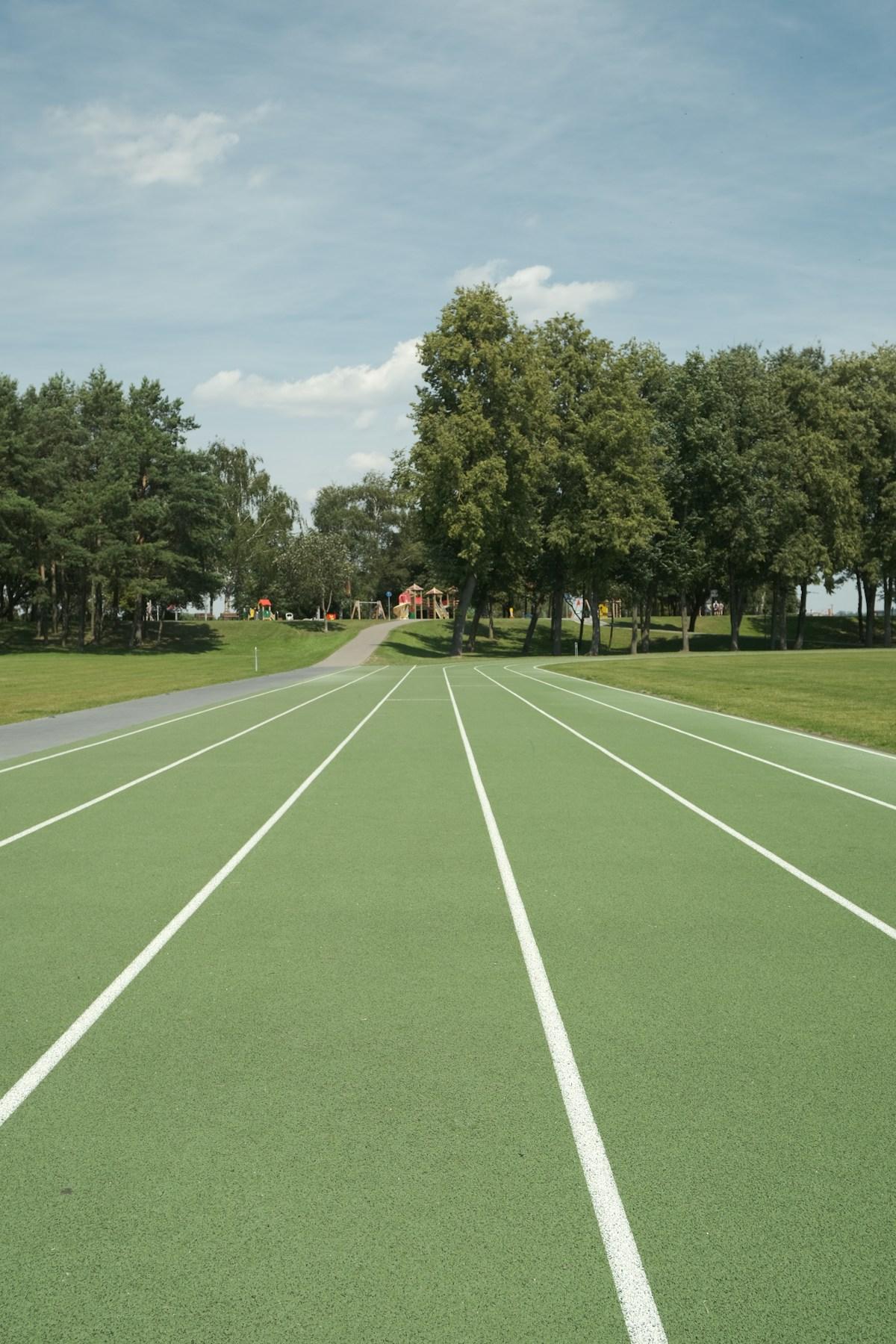
Um estádio de atletismo moderno é construído a partir de dois sistemas de superfície completamente diferentes, e nunca são fornecidos pelo mesmo contratante. O primeiro é o pista de corrida: um contínuo 400 m oval de poliuretano vazado, acabamento com uma camada de desgaste texturizada e linhas de pista moldadas. Marcas como Mondotrack, Beynon, seu recorde, e Polytan dominam esta categoria, e o material é misturado, nivelado, e curado no local por um especialista em superfícies esportivas. Não tem relação com grama artificial — é um elastômero de aplicação líquida, não é um têxtil.
O segundo sistema é o gramado interno: o retângulo verde fechado dentro do oval de poliuretano. Este é o único tapete que uma fábrica de grama envia para um projeto de atletismo, e sua área ocupada é dramaticamente menor que a envolvente do estádio. Uma instalação padrão de 8 pistas ocupa um terreno de aproximadamente 177 m × 93 m = 16,461 m², mas a ordem da grama cobre apenas o retângulo interno de 84 m × 73 m = 6,132 m². A diferença — mais do que 10,000 m² — é ocupado pelos oito 1.22 m pistas, o meio-fio, os drenos perimetrais, as margens de escoamento, e o sprint direto.
Confirmar esta divisão de superfície antes da licitação é o que protege o orçamento. O empreiteiro da pista precifica o poliuretano por metro de pista; a fábrica de turfa preços carpete por m². Envie a cada fornecedor apenas o retângulo pelo qual ele é responsável, e as duas ordens nunca se sobrepõem. Para uma análise personalizada do seu retângulo interno exato, nosso grama artificial equipe prepara um dentro 24 horas.

O que há dentro do campo interno: Várias subzonas
Visualmente, o campo interno parece um campo verde contínuo. Estruturalmente, é uma colcha de retalhos de zonas especializadas, cada um com suas próprias marcações, perfil de desgaste, e às vezes sua própria especificação de grama. Tratando o 6,132 m² como carpete único e uniforme é o segundo erro de planejamento mais comum — o layout deve antecipar o que acontece dentro do retângulo antes que a contagem dos rolos seja finalizada.
As subzonas que um campo interno de competição deve acomodar incluem:
- Jogando círculos — Os círculos de arremesso de peso e disco são anéis de concreto ou aço alinhados com a grama, com o carpete circundante cortado precisamente ao redor deles. Os setores de pouso se espalham pela grama e exigem pilhas de maior densidade para sobreviver aos repetidos impactos.
- Pistas de salto — salto em distância, salto triplo, e as pistas de salto com vara são retas, tiras totalmente relvadas com marcações de aproximação embutidas de fábrica. A prancha de decolagem e a caixa de plantas ficam a distâncias precisas para que o carpete não possa distorcer.
- Ventilador de salto em altura — um avental curvo em forma de D onde os atletas se aproximam da barra. A área do leque precisa de uma altura de pilha consistente e uma base tolerante porque a planta e o salto geram carga lateral concentrada.
- Pista de dardo — junto, pista estreita relvada (frequentemente 30–36 eu) levando ao arco de arremesso, com as linhas do setor estendendo-se até a área de pouso.
Essas zonas ditam duas coisas na fábrica. Primeiro, alguns — particularmente jogando áreas de pouso — pode precisar de uma pilha mais densa ou mais curta para resistir ao impacto de um lançamento de dardo ou tiro, enquanto a superfície de aquecimento geral pode ser mais alta, fibra mais macia. Segundo, cada linha de pista e setor deve ser incrustada de fábrica em branco, o que significa que a quantidade de grama deve ser especificada na cotação, não adicionado posteriormente. O campo interno também funciona como espaço de aquecimento e recuperação durante as competições, então a área verde aberta entre as zonas não é excedente — é um gramado funcional que os atletas usam entre as tentativas.
Padrão Mundial de Planicidade do Atletismo: A regra dos 6 mm
Um campo interno de atletismo é submetido a uma tolerância de planicidade mais rigorosa do que quase qualquer outra superfície esportiva, e o padrão é aplicado pelo órgão regulador do esporte. O Atletismo Mundial (antiga IAAF) Manual de instalações de atletismo especifica que, sob um 4 m régua colocada em qualquer lugar do campo, nenhuma depressão pode exceder 6 milímetros. Irregularidades escalonadas — mudanças bruscas de nível entre dois pontos — são limitados em 1 milímetros.
Esta tolerância é um requisito de preparação de base, não é uma propriedade de carpete. A sub-base — geralmente pedra britada projetada, asfalto, ou concreto — devem ser examinados e nivelados a laser para atender às 6 regra mm antes os rolos de grama são desenrolados. Se a base falhar no teste de régua, nenhuma quantidade de qualidade do carpete fará com que a superfície acabada esteja em conformidade, e a instalação não pode ser certificada. O contratante básico, não a fábrica de grama, possui esse risco; o instalador da relva simplesmente confirma as passagens da base antes de colocar a primeira faixa.
Por que a grama natural falha em campos internos
Vale a pena perguntar por que praticamente todas as instalações de atletismo certificadas abandonaram a grama natural dentro do oval décadas atrás. A resposta não é apenas a estética ou o custo de manutenção — é que a grama natural fisicamente não pode sobreviver ao esporte. Três modos de falha tornam um campo interno natural impossível de jogar em uma única temporada competitiva.
Primeiro, instrumentos de arremesso destroem a superfície com o impacto. Um dardo de competição pousa de ponta-cabeça em alta velocidade e se enterra na grama, rasgando um pedaço de cada vez. Um arremesso de peso caído ou rolado na grama comprime o solo e mata a copa da planta. Desembarques de disco vasculham o setor de pouso. Dentro de semanas de treinamento regular, os setores de arremesso em um campo interno natural tornam-se manchas de terra.
Segundo, zonas de alto desgaste transformam-se em lama. A abordagem à prancha de decolagem do salto em distância, a área da fábrica de salto com vara, e o perímetro onde os atletas se aquecem vêem o tráfego de pedestres concentrado. Na relva natural estas zonas são compactas, perder drenagem, e se transformar em lama na primeira chuva. Um campo interno molhado força atrasos ou cancelamentos de eventos — um resultado que nenhuma competição certificada pode tolerar.
Terceiro, o a exigência de qualquer clima não é negociável. A certificação World Athletics pressupõe que a instalação sedia eventos durante todo o ano, e uma reunião não pode ser adiada porque a grama está encharcada. A grama sintética drena através do suporte poucos minutos após a chuva, contém marcações incrustadas permanentes, e fornece uma superfície consistente tanto para a aproximação da pista quanto para o setor de pouso. É por isso que a grama sintética substituiu a grama natural em praticamente todas as instalações certificadas — é a única superfície que atende às demandas de desempenho e tempo de atividade do esporte.
Layout de rolo: Cobrindo um 84 m × 73 m Retângulo
O teste de atletismo padrão da indústria é 4 m de largura × 25 m de comprimento = 100 m² por rolo. Cobrindo um 84 m × 73 m campo interno é, portanto, um problema de nidificação: como colocar o 4 tiras de largura m para que as costuras sejam minimizadas, a direção da pilha é uniforme, e sobras são recuperadas em vez de jogadas fora. A aritmética é direta, mas a direção da postura altera materialmente a contagem de rolos.
A abordagem ingênua atravessa o 73 m largura. Dividindo 73 m por 4 m dá 18.25 tiras, arredondado para 19. Cada tira é 84 tenho comprimento, então precisa 84 ÷ 25 = 3.36 comprimentos de rolo, arredondado para 4 rolos por tira. Multiplicando 19 tiras × 4 rola dá 76 rolos — mas esse número ignora o corte do restante da largura da tira de 0,75 e o 0.64 restante do comprimento do rolo em cada tira.
O layout eficiente comanda os rolos longitudinalmente ao longo 84 dimensão m. O 73 m largura ainda se divide em 19 tiras de 4 eu, mas cada um 84 m tira consome apenas 3.36 comprimentos de rolo, e os comprimentos parciais das tiras adjacentes podem ser aninhados. A pegada bruta de 6,132 m²÷ 100 m² por rolo dá um piso de 62 rolos com desperdício zero; adicionando o padrão 5% margem para costuras, corte de perímetro, e linhas embutidas trazem a ordem prática para 65 rolos (6,439 m²).
Pedido ~6.439 m² — aproximadamente 65 rolos
4 m × 25 m rolos (100 m² cada) · Área interna de 8 pistas 6,132 m² + 5% resíduos · corre longitudinalmente ao longo do 84 dimensão m
Uma decisão de layout deve ser bloqueada na cotação: direção da pilha. A fibra de cada tira se inclina para um lado, e se duas faixas adjacentes se opõem, a junção aparece como uma faixa colorida visível sob holofotes. Todas as tiras devem correr na mesma direção — geralmente em direção à arquibancada principal — portanto, a contagem de rolos deve levar em conta a orientação correta desde a primeira cotação, não ser corrigido no local.
Linha Relva: Por que as linhas brancas devem ser incrustadas de fábrica
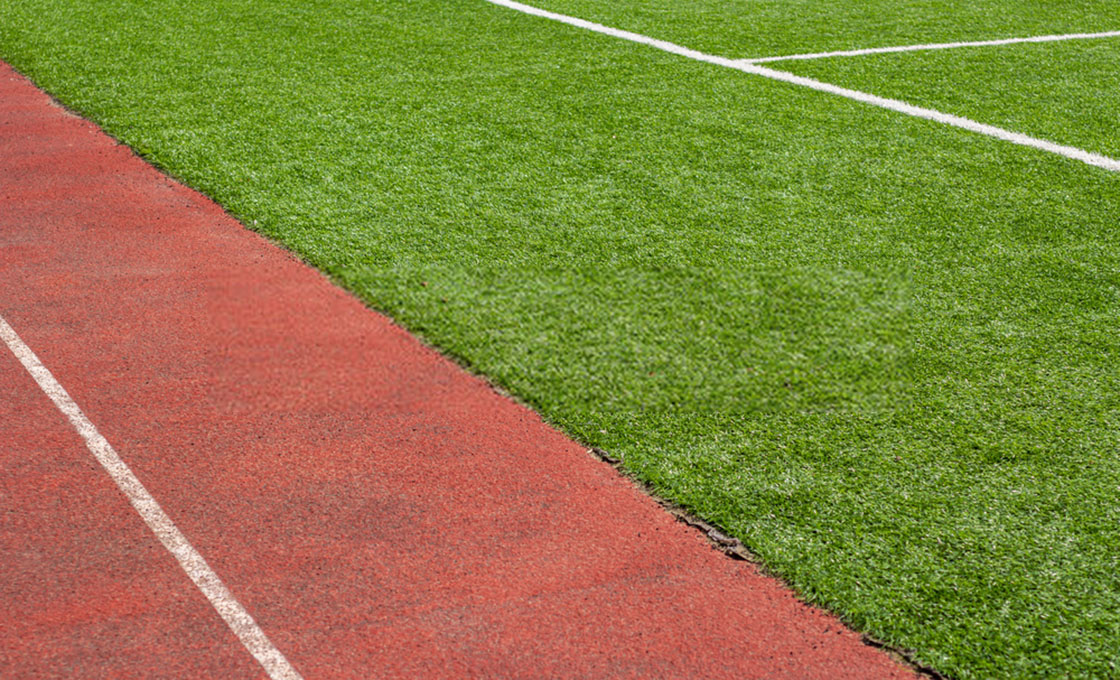
Cada marcação de pista, linha do setor, e o limite em um campo interno de competição é uma linha branca permanente, e a forma como essas linhas são produzidas determina se o campo permanecerá certificado por uma década ou perderá suas marcações em uma única temporada. O único método compatível é grama de linha embutida de fábrica: fio branco tufado no tapete verde durante a produção, na posição e largura exatas que o layout exige.
Um campo interno padrão de 8 pistas transporta aproximadamente 240 m² de grama de linha branca — o comprimento cumulativo das pistas de salto em distância e salto triplo, abordagens de salto com vara, curvas de ventilador de salto em altura, pistas de dardo, lançando linhas setoriais, e o limite interno contra o meio-fio da pista. Que 240 m² não é um pedido separado; é produzido no mesmo lote do tapete verde, na mesma máquina de tufos, então o lote de tintura combina perfeitamente. Uma linha produzida em um lote diferente desenvolve uma incompatibilidade de tonalidade visível em relação ao verde dentro de meses de exposição aos raios UV.
Especificar o layout da linha antecipadamente também bloqueia o plano de corte em rolo. Porque as linhas são tufadas no carpete em posições fixas, cada rolo é cortado em uma faixa específica do campo interno com suas linhas já colocadas. É por isso que a quantidade de grama linear, a programação da linha, e o tapete verde devem ser todos confirmados em um único lote de produção — dividi-los em pistas faz com que as linhas e o verde sejam irreversivelmente incompatíveis.
Níveis de preços
Preço FOB de fábrica para extensões de grama interna de atletismo $8 para $25 por m², definido pela altura da pilha, densidade do ponto, tipo de fibra, e se o tapete contém dados de teste de certificação da World Athletics. Três níveis cobrem a gama realista de projetos de estádios e treinamentos. Os números abaixo são FOB China apenas para material, excluindo frete, instalação, e preencher.
| Nível | Classe de instalação | FOB $/m² | Custo para 8 pistas (6,439 m²) |
|---|---|---|---|
| Treinamento / Comunidade | Escola, municipal, recreação | $8 – $15 | $51,500 – $96,600 |
| Nacional / Clube | Competição de clubes, encontros regionais | $12 – $20 | $77,300 – $128,800 |
| Certificado Mundial de Atletismo | Internacional, estádio certificado | $15 – $25 | $96,600 – $160,975 |
O nível premium traz dados de teste de certificação — o tapete foi testado em laboratório quanto à fricção, deformação, e comportamento vertical da bola de acordo com os critérios de desempenho do World Athletics, e o relatório do teste acompanha a remessa. Uma trilha comunitária não precisa desses dados; um local internacional não pode sediar um encontro sancionado sem ele. Confirme o requisito de certificação antes de selecionar um nível, porque o custo do teste é amortizado no preço por m².
Peso e Recipientes
Um campo interno de atletismo é uma das remessas mais limpas no transporte de grama esportiva. Aproximadamente 3.5 kg por m² de carpete, um pedido padrão de 8 pistas pesa 6,132 m² × 3.5 kg/m² = 21.5 toneladas, mais o peso da linha-grama e da embalagem. Essa carga cai confortavelmente dentro dos 26–28 teto de toneladas de um único 40 pés de contêiner de alto cubo, e o 65 rolos embalados dentro do volume de aproximadamente 68 m³ do contêiner, sem divisão.
| Configuração | Encomendar m² | Peso (~3,5kg/m²) | Envio |
|---|---|---|---|
| Somente área de arremesso | 2,100 m² | 7.4 t | LCL ou 1 × 20 pés |
| 6-treinamento de pista | 4,725 m² | 16.5 t | 1 × 40 pés HQ |
| 8-padrão de pista | 6,439 m² | 22.5 t | 1 × 40 pés HQ |
| 2 × Complexo de 8 pistas | 12,878 m² | 45.1 t | 2 × 40 pés HQ |
Para o campo interno único de 8 pistas, o título é simples: um 40 ft HQ container transporta todo o pedido. A carga útil de 22,5 toneladas fica abaixo do limite de peso, o 65 rolos cabem dentro do volume, e não há remessa dividida para coordenar. Este é um dos recipientes mais limpos na categoria de gramados esportivos — um campo de futebol com aproximadamente 7.000 m² geralmente chega ao limite de peso, enquanto um campo interno de atletismo cai exatamente no meio da distância.
Exemplo de pedido de compra: Um campo interno de estádio padrão de 8 pistas
Esta é a lista de materiais que um gerente de projeto coloca em um pedido de compra para um único campo interno de 8 pistas padrão da World Athletics. O tapete é o item da manchete; o gramado de linha embutida para sinalização de pista e setor é produzido no mesmo lote e enviado dentro do total do pedido; o peso e a linha do contêiner informam ao despachante como movê-lo. Cada figura deriva do 84 m × 73 m pegada mais um 5% subsídio de resíduos.
| Item | Especificações | Quantidade |
|---|---|---|
| Tapete verde no campo | 4 m × 25 m rolos, 100 m² cada | ~6.199 m² |
| Relva de linha (pista & marcações do setor) | Branco, embutido de fábrica | ~240 m² |
| Quantidade total do pedido | incluindo. 5% desperdício | 6,439 m² (65 rolos) |
| Peso bruto | ~3,5kg/m² | ~22,5 toneladas |
| Envio | 40 pés de contêiner HQ | 1 × 40 pés HQ |
| Valor FOB | $8 – $25 / m² | $51,500 – $160,975 |
Erros Comuns (Específico para Atletismo)
Erro 1 — Citando a pegada oval completa. O 177 m × 93 m envelope do estádio é 16,461 m², mas a pista de corrida é de poliuretano e os ralos e o meio-fio não são de grama. Encomendar com o envelope cheio significa comprar aproximadamente 10,000 m² de carpete sem onde colocá-lo. Sempre informe o fabricante sobre o 84 m × 73 m retângulo interno apenas.
Erro 2 — Ignorando o 6 regra de planicidade mm na base. A tolerância reta do World Athletics é um requisito básico de preparação, não é uma propriedade de carpete. Se a sub-base falhar, o 6 teste mm, nenhuma qualidade de carpete resgatará a certificação. Pesquise e nivele a base com laser antes encomendando grama, não depois que os rolos chegarem.
Erro 3 — Esquecendo a divisão do gramado na cotação. Os ~240 m² de grama branca devem ser produzidos no mesmo lote do tapete verde. Se não for especificado antecipadamente, os navios-fábrica 100% tapete verde e o projeto fica pintando linhas temporárias que desaparecem em uma única temporada competitiva.
Erro 4 — Dividindo um complexo multicampo em lotes. A cor da grama artificial muda sutilmente entre as execuções de produção. Dois campos internos colocados em lotes diferentes desenvolvem uma incompatibilidade de cores visível que as câmeras de transmissão detectam imediatamente e nenhuma manutenção pode corrigir. Agregue todos os campos internos de um complexo em um único pedido de lote.
Erro 5 — Encomendar o nu 6,132 m² sem desperdício. Um grande campo interno retangular ainda gera cortes em cada recorte perimetral, junção de costura, e linha embutida. UM 5% subsídio é o mínimo; ordenar a pegada exata deixa a tira final aproximadamente 300 m² curto, interromper a instalação durante quatro a seis semanas que um novo pedido leva para ser enviado da China.
Perguntas frequentes
Quanta grama artificial eu preciso para uma pista de atletismo?
Um campo interno padrão de 8 pistas mede 84 m × 73 m = 6,132 m². Adicionando um 5% o subsídio para resíduos dá uma ordem de aproximadamente 6,439 m² — 65 rola em 100 m² cada (4 m × 25 eu) — incluindo aproximadamente 240 m² de grama de linha branca embutida de fábrica. Este valor vai direto para um pedido de compra.
A pista de corrida é feita de grama artificial?
Não. O 400 m oval, as oito pistas, e o sprint direto é derramado em poliuretano — fornecido sob marcas como Mondotrack, Beynon, ou Rekortan por um empreiteiro especializado em superfícies esportivas. Apenas o retângulo interno delimitado pelo oval é grama artificial. Envie ao fabricante da grama apenas as dimensões do campo interno, nunca o completo 177 m × 93 m pegada do estádio.
Qual é o padrão de planicidade da World Athletics para um campo interno??
Nenhuma depressão maior que 6 mm sob um 4 régua, e nenhuma irregularidade escalonada maior que 1 milímetros. Esta tolerância é mais rigorosa que a de um campo de futebol e aplica-se à sub-base, não o tapete — a base deve ser examinada e nivelada a laser para alcançá-la antes de qualquer grama ser instalada. O padrão está documentado no Manual de Instalações de Atletismo da World Athletics.
Quantos contêineres de transporte um único campo interno precisa?
Um 40 pés de contêiner de alto cubo. Uma ordem padrão de 8 pistas é 6,439 m² aproximadamente 3.5 kg/m² — sobre 22.5 toneladas, confortavelmente abaixo dos 26–28 teto de carga útil em toneladas. O 65 os rolos também cabem no volume de aproximadamente 68 m³ do contêiner, então um único campo interno é enviado em uma caixa sem divisão.
Por que as linhas brancas devem ser incrustadas de fábrica em vez de pintadas?
As linhas incrustadas na fábrica são fios brancos tufados no tapete verde durante a produção — eles são permanentes e duram toda a vida útil do carpete. As linhas pintadas desaparecem em uma única temporada competitiva devido ao tráfego de pedestres e ao clima. Os ~240 m² de grama linear também devem ser produzidos no mesmo lote do tapete verde para garantir a correspondência do lote de tingimento.
Solicite um orçamento direto da fábrica para o campo interno do seu estádio
Envie-nos suas dimensões internas, contagem de pistas, e nível de certificação alvo. Devolvemos uma lista completa de materiais — carpete m², contagem de rolos, divisão de grama, peso, plano de contêiner, e preços FOB — dentro de 24 horas. Fabricação de grama artificial esportiva desde 2006, exportado para 50+ países.
Conheça a configuração e a pegada do seu campo? Envie-nos suas dimensões internas e nível de destino — devolvemos uma lista completa de materiais cobrindo a quantidade de carpetes em rolos, divisão de grama, peso, plano de contêiner, e preços FOB dentro 24 horas. A Relyir fabrica grama artificial esportiva desde 2006, exportando para 50+ países.